Test Index
CBSE Class 12 Physics 2020 Outside Delhi Set 1 Paper
© examsnet.com
Question : 36 of 37
Marks:
+1,
-0
(a) Draw the ray diagram showing refraction of ray of light through a glass prism. Derive the expression for the refractive index of the material of prism in terms of the angle of prism and angle of minimum deviation . (b) A ray of light enters an isosceles rightangled prism of refractive index as shown in figure. 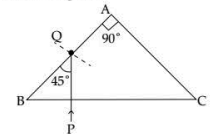 (i) Trace the path of the ray through the prism. (ii) What will be the effect on the path of the ray if the refractive index of the prism is 1.4? OR (a) Two thin lenses are placed coaxially in contact. Obtain the expression for the focal length of this combination in terms of the focal lengths of the two lenses. (b) A converging lens of refractive index 1.5 has a power of . When it is completely immersed in a liquid, it behaves as a diverging lens of focal length . Find the refractive index of the liquid.
Solution:
(a) 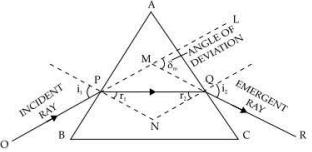 is the incidence ray on the prism and emergent ray. For minimum deviation, So, Also, So, Now, from snell's law, (b)(i)
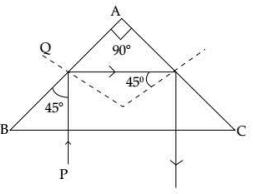 The critical angle .So, the ray which is incident on surface will be reflected making an angle .The angle of incidence on surface is also ; so, the ray will be reflected making an angle .The ray is incident normally on the surface BC. So, there will be no deviation due to refraction.(ii) If , then the critical angle .So, the ray will be refracted out from the face.
 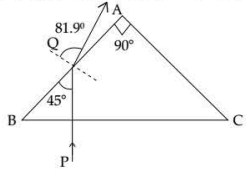 Angle of incidence So, the ray will be refracted out making an angle of refraction . OR (a) Consider two thin lenses and of focal length and are placed coaxially in contact with each other. The lenses are so thin that their optical centers are assumed to coincide at point .
 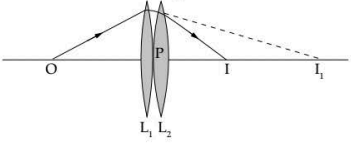 An object is placed at on the common principal axis. The lens produces an image at and this image acts as the object for the second lens . The final image is produced at as shown in figure., object distance for the first lens ,, final image distance and, image distance for the first lens object distance for second lens .For the image produced by the first lens ......(1) For the final image I, produced by the second lens , .......(2) Adding equations (1) and (2), .......(3) If the combination is replaced by a single lens of focal length such that it forms the image of at the same position , then ......(4) Comparing equations (3) and (4), (b) Refractive index of the medium of lens Power of the lens Focal length of the lens In liquid, its focal length According to lens makers' formula Or, .......(1)In the liquid, Or, .......(2) Dividing eqn (1) by eqn (2), Or, Refractive index of the liquid medium
© examsnet.com
Go to Question: