Test Index
CBSE Class 12 Physics 2023 Delhi Set 1 Paper
© examsnet.com
Question : 33 of 35
Marks:
+1,
-0
(a) (i) Draw a ray diagram to show the working of a compound microscope. Obtain the expression for the total magnification for the final image to be formed at the near point. (ii) In a compound microscope an object is placed at a distance of from the objective of focal length . If the eye-piece has a focal length of and the final image is formed at the near point, find the magnifying power of the microscope. OR(b) (i) Draw a ray diagram for the formation of image of an object by an astronomical telescope, in normal adjustment. Obtain the expression for its magnifying power.(ii) The magnifying power of an astronomical telescope in normal adjustment is and the objective and the eyepiece are separated by a distance of . Find the focal lengths of the two lenses.
Solution: 👈: Video Solution
(a) (i) Ray diagram of compound microscope: 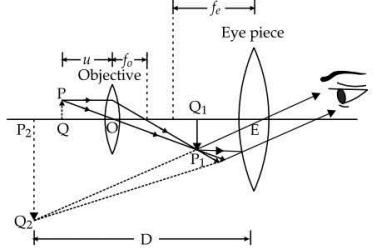 In a compound microscope there are two lenses - objective and Eyepiece . Object is placed in front of the objective at a distance more than the focal length of the objective. An inverted, magnified, real image is formed in front of eyepiece within the optical centre and the focus of the eyepiece. This acts as the object of the eyepiece. An (erect with respect to , inverted with respect to ), magnified, virtual image is formed at a distance (minimum distance of distinct vision) from the eyepiece. Magnification: For objective: Object distance Image distance Applying the lens formula, Or, Or, For eyepiece: Magnification of the combination of objective and eyepiece image is formed very close to the eyepiece, hence can be approximated as the distance between the two lenses i.e., the length of the tube(L). Since, and , hence the above expression may be approximated as, (ii) Given, Here, all alphabets are in their usual meanings Applying lens formula for objective lens, Magnification OR (b) (i) Astronomical telescope in normal adjustment:
 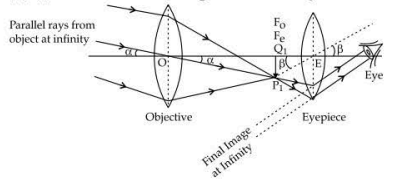 In an astronomical telescope there are two lenses - objective and Eyepiece .The two lenses are so placed during focussing that the foci of the lenses meet at a point.Objective is directed towards the object at infinity.Parallel rays coming from the object meet at the focus of the objective and forms an inverted, real image in front of eyepiece. This point is the focus of eyepiece too.This acts as the object of the eyepiece. An (inverted with respect to , erect with respect to original object), highly magnified, real image is formed at infinity.Magnification Or, Or, [ and being very small, and ] Or, Or, ∴
© examsnet.com
Go to Question: