Test Index
CBSE Class 12 Physics 2023 Delhi Set 1 Paper
© examsnet.com
Question : 34 of 35
Marks:
+1,
-0
SECTION - E
A lens is a transparent optical medium bounded by two surfaces; at least one of which should be spherical. Considering image formation by a single spherical surface successively at the two surfaces of a lens, lens maker's formula is obtained. It is useful to design lenses of desired focal length using surfaces of suitable radii of curvature. This formula helps us obtain a relation between and for a lens. Lenses form images of objects and they are used in a number of optical devices, for example microscopes and telescopes. (i) An object is kept in front of a composite convex lens, as shown in figure. Will the lens produce one image? If not, explain.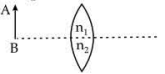
Solution: 👈: Video Solution
(i) No, the lens will not produce one image. It will produce two images. Refractive index upper and lower section of the lens being different there will be two foci and hence, two images will be formed. 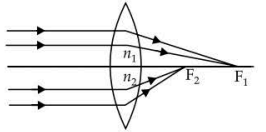 (ii) If the screen is removed, the image will be still formed and it can be seen by looking through the lens through the specific cone of light.
 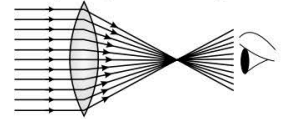 (iii) Using lens maker's formula OR The equivalent focal length of two lenses separated by a distance be Or, Or, When a point object is kept distance from this lens combination, the rays emerge as parallel to the principal axis. So, focal length of the combination is .
© examsnet.com
Go to Question: