Test Index
CBSE Class 12 Physics 2023 Delhi Set 1 Paper
© examsnet.com
Question : 35 of 35
Marks:
+1,
-0
A capacitor is a system of two conductors separated by an insulator. The two conductors have equal and opposite charges with a potential difference between them. The capacitance of a capacitor depends on the geometrical configuration (shape, size and separation) of the system and also on the nature of the insulator separating the two conductors. They are used to store charges. Like resistors, capacitors can be arranged in series or parallel or a combination of both to obtain desired value of capacitance. (i) Find the equivalent capacitance between points and in the given diagram. 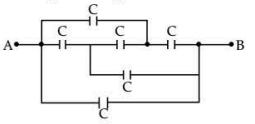 (ii) A dielectric slab is inserted between the plates of a parallel plate capacitor. The electric field between the plates decreases. Explain. (iii) A capacitor A of capacitance , having charge is connected across another uncharged capacitor of capacitance 2C. Find an expression for (a) the potential difference across the combination and (b) the charge lost by capacitor A. OR (iii) Two slabs of dielectric constants and fill the space between the plates of a parallel plate capacitor of plate area and plate separation as shown in figure. Find an expression for capacitance of the system.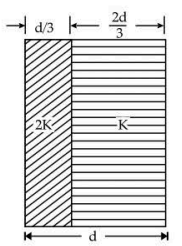
Solution: 👈: Video Solution
Ans. (i) The given combination: 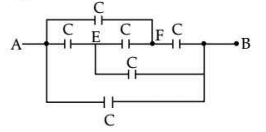 Initially the capacitor between A and B is not considered. So, the circuit may be redrawn as
 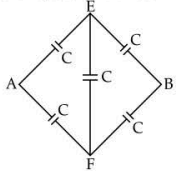 This is like a balanced Wheatstone bridge. So, the capacitor between and may not be considered. So, the circuit is further modified as
 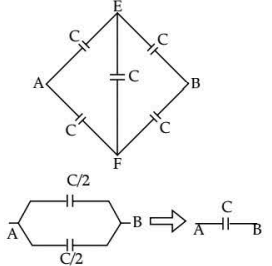 The capacitance between and is . Now capacitor between A and B (left out initially) is considered.
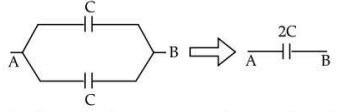 So, the equivalent capacitance between and is . (ii) When a dielectric is placed between charged plates of a capacitor, the polarization of dielectric produces an electric field opposing the field produced by the charges on the plate. Thus, the resultant electric field between the plates decreases. (iii) Both capacitors will attain a common potential, . (a) (b) Final charge on capacitor So, charge lost by capacitor OR By placing the dielectric slab, it behaves like two capacitors in series Or, Or, ∴
© examsnet.com
Go to Question: