Test Index
CBSE Class 12 Physics 2023 Outside Delhi Set 1 Paper
© examsnet.com
Question : 30 of 35
Marks:
+1,
-0
(a) (i) Distinguish between nuclear fission and fusion giving an example of each. (ii) Explain the release of energy in nuclear fission and fusion on the basis of binding energy per nucleon curve. OR (b) (i) How is the size of a nucleus found experimentally? Write the relation between the radius and mass number of a nucleus. (ii) Prove that the density of a nucleus is independent of its mass number.
Solution: 👈: Video Solution
(a) (i) Nuclear fission & fusion:
(ii) In nuclear fusion, the binding energy of the products is greater than the binding energy of reactants. In nuclear fission, binding energy of fragments is greater than the binding energy of the parent. This difference in binding energy is released in form of energy. OR (b) (i) Experimental determination of size of nucleus: Size of nucleus was determined experimentally by Rutherford by his alpha particle scattering experiment. 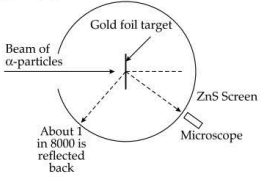 In the experiment, a gold foil of thickness was bombarded by energetic -particles generated from source.Scattered -particles were observed on a screen with the help of a microscope.It was observed that most of the -particles passed through the gold foil undeviated.About -particles were scattered by an angle more than .1 out of -particles was scattered by an angle more than .Very few -particles was scattered by an angle .From these observations Rutherford calculated the impact parameter and distance of closest approach and concluded that the size of nucleus lies between and .Relation between radius and mass number: (ii) Density of nucleus is independent of mass number: or, or, Hence, it is independent of mass number.
| Nuclear fission | Nuclear fusion |
|---|---|
| Heavy nucleus splits into comparatively lighter nuclei. | Lighter nuclei fuse to form comparatively heavier nuclei. |
| Energy released is less than that of fusion. | Energy released is more than that of fission. |
| Does not naturally occur. | Occur naturally in stars. |
| Comparatively less amount of energy required to start the process. | Huge amount of energy is required to start the process. |
| Application: Atomic bomb | Application: Hydrogen bomb |
| Example: |
© examsnet.com
Go to Question: