Test Index
CBSE Class 12 Physics 2023 Outside Delhi Set 1 Paper
© examsnet.com
Question : 31 of 35
Marks:
+1,
-0
(a) (i) Use Gauss' law to obtain an expression for the electric field due to an infinitely long thin straight wire with uniform linear charge density . (ii) An infinitely long positively charged straight wire has a linear charge density . An electron is revolving in a circle with a constant speed such that the wire passes through the centre, and is perpendicular to the plane, of the circle. Find the kinetic energy of the electron in terms of magnitudes of its charge and linear charge density on the wire. (iii) Draw a graph of kinetic energy as a function of linear charge density . OR (b) (i) Consider two identical point charges located at points and .(1) Is there a point on the line joining them at which the electric field is zero?(2) Is there a point on the line joining them at which the electric potential is zero?Justify your answers for each case.(ii) State the significance of negative value of electrostatic potential energy of a system of charges.Three charges are placed at the corners of an equilateral triangle of side as shown in figure. Calculate the electric potential energy of the system of three charges. 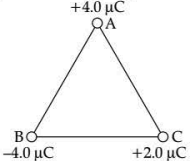
Solution: 👈: Video Solution
(a) (i) Electric field due to an infinitely long thin straight wire with uniform linear charge density:Linear charge density A point is considered at a distance where the electric field is to be determined. 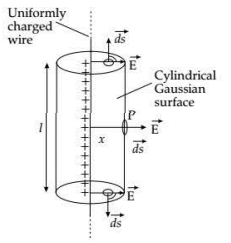 A cylindrical Gaussian surface of length and radius is considered with the wire as its axis. Magnitude of electric field at every point the curved surface of the cylinder is same and is directed outward making an angle with the direction of area vector . Electric fields at the two flat surfaces of the cylinder are zero since, the direction of electric field through those surfaces and the direction of area vector are perpendicular. So, total flux through the curved surface According to Gauss' law, (ii) Electric field produced by an infinitely long straight charged wire, This field provides the centripetal force to the revolving electron. or, or, Kinetic energy (iii) The required equation, It is the equation of a straight line passing through the origin.
 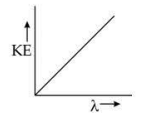 OR (b) (i) (1) Yes, Electric field will be zero at point. At this point the magnitudes of both the electric fields are same in magnitude and are oppositely directed.(2) Electric potential will not be zero at any point since at every point the potential will be the summation of both the potentials and both charges are of similar nature.(ii) Significance of negative electrostatic potential energy:Negative electrostatic potential energy of a system of charges means work is to be done against the field to move the charges apart.
 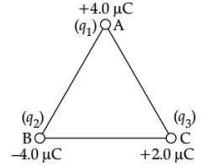 Potential energy due to charges at A and BPotential energy due to charges at and Potential energy due to charges at and Net potential energy of the system of three charges.
© examsnet.com
Go to Question: