Test Index

Systems of Particles and Rotational Motion

© examsnet.com
Question : 20 of 33
Marks: +1, -0
The oxygen molecule has a mass of 5.30×10265.30 \times 10^{-26} kg and a moment of inertia of 1.94×1046kgm21.94 \times 10^{-46} \mathrm{kg}\,\mathrm{m}^2 about an axis through its centre perpendicular to the lines joining the two atoms. Suppose the mean speed of such a molecule in a gas is 500m s1500 \text{m s}^{-1} and that its kinetic energy of rotation is two thirds of its kinetic energy of translation. Find the average angular velocity of the molecule.
Solution:  
Here,m=5.30×1026kg,m = 5.30 \times 10^{-26} \text{kg},
I=1.94×1046kgm2,v=500m s1I = 1.94 \times 10^{-46} \,\mathrm{kg}\,\mathrm{m}^2, v = 500 \,\text{m s}^{-1}
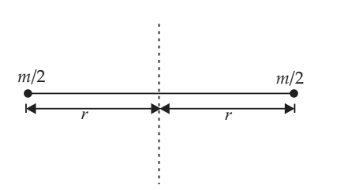
Ifm2\frac{m}{2} is mass of each atom of oxygen and 2r2r is distance between the two atoms as shown in figure, then
I=m2r2+m2r2=mr2I = \frac{m}{2} r^{2} + \frac{m}{2} r^{2} = m r^{2}
r=Imr = \sqrt{\frac{I}{m}} =1.94×10465.3×1026= \sqrt{\frac{1.94 \times 10^{-46}}{5.3 \times 10^{-26}}}
=0.61×10¹⁰m= 0.61 \times 10^{-10} \text{m}
As K.E.\text{K.E.} of rotation =23K.E.= \frac{2}{3} \text{K.E.} of translation
12Iω2=23×12mv2\therefore \frac{1}{2} I \omega^{2} = \frac{2}{3} \times \frac{1}{2} m v^{2}
12mr2ω2=13mv2\Rightarrow \frac{1}{2} m r^{2} \omega^{2} = \frac{1}{3} m v^{2}
ω=23vr\omega = \sqrt{\frac{2}{3}} \frac{v}{r}
=23×5000.61×1010= \sqrt{\frac{2}{3}} \times \frac{500}{0.61 \times 10^{-10}}
=6.7×10¹²rad s1= 6.7 \times 10^{12} \text{rad s}^{-1}
© examsnet.com
Go to Question: