Test Index

Systems of Particles and Rotational Motion

© examsnet.com
Question : 5 of 33
Marks: +1, -0
Show that a.(b×c)\overset{\rightarrow}{a}.\left(\overset{\rightarrow}{b}\times\overset{\rightarrow}{c}\right) is equal in magnitude to the volume of the parallelepiped formed on the three vectors, a,b\overset{\rightarrow}{a},\overset{\rightarrow}{b} and c\overset{\rightarrow}{c}
Solution:  
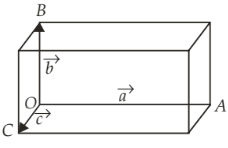
Let a parallelopiped be formed on the three vectors
OA=a,OB=b\overset{\rightarrow}{OA}=\overset{\rightarrow}{a}, \overset{\rightarrow}{OB}=\overset{\rightarrow}{b}and OC=c\overset{\rightarrow}{OC}=\overset{\rightarrow}{c}
Now, b×c=bcsin90n^=bcn^\overset{\rightarrow}{b}\times\overset{\rightarrow}{c}=bc\sin 90^{\circ}\hat{n}=bc\hat{n}
where n^\hat{n} is unit vector along OA\overset{\rightarrow}{OA} perpendicular to the plane containing b\overset{\rightarrow}{b} and c.\overset{\rightarrow}{c}.
Now a.(b×c)\overset{\rightarrow}{a}.\left(\overset{\rightarrow}{b}\times\overset{\rightarrow}{c}\right) =a.bcn^=(a)(bc)cos0=abc=\overset{\rightarrow}{a}. bc\hat{n}=(a)(bc)\cos 0^{\circ}=abc
which is equal in magnitude to the volume of the parallelopiped.
© examsnet.com
Go to Question: