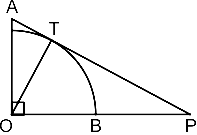
Concept:The radius of a circle is perpendicular to the tangent at the point of contact. In the given figure, OT is the radius and PT is tangent to the circle, so triangle OTP is right‑angled at T. Using the Pythagorean theorem we can relate the known lengths to find
r.
Explanation:Denote the radius
OT=OB=r (both are radii of the same quadrant). The length
PB=36 cm is the part of the line from the centre O to point P that lies outside the circle. Hence the distance from O to P is
OP=OB+PB=r+36 cm.
Given that
PT=96 cm is the tangent segment, and
∠OTP=90∘. Therefore in right‑angled
â–³OTP:
OP2=OT2+PT2Substitute the values:
(r+36)2=r2+962Expand:
r2+72r+1296=r2+9216Cancel
r2 from both sides:
72r+1296=9216So
72r=9216−1296=7920Thus
r=727920​=110 cm.
Alternatively, the same result can be obtained using the tangent‑secant theorem:
PT2=PB×PC, where
PC=PB+2r=36+2r. Solving gives
2r=220, so
r=110 cm.
Answer:The radius of the circle is 110 cm, which corresponds to option C.