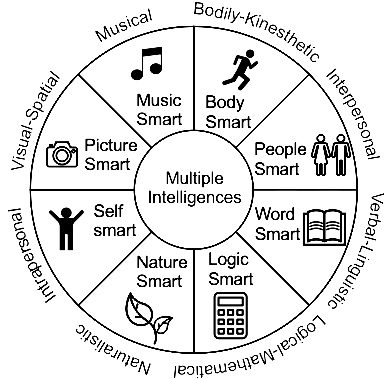
Concept:Howard Gardner's theory proposes that intelligence is not a single fixed ability but a set of multiple distinct intelligences, meaning every individual has strengths in different areas, so nearly all students can be considered "intelligent" in some way.
Explanation:The theory identifies at least eight intelligences (e.g., linguistic, logical‑mathematical, spatial, bodily‑kinesthetic, musical, interpersonal, intrapersonal, naturalistic). No student excels in all, but each has a unique profile of strengths. For instance, a student weak in math may be strong in music or interpersonal skills. Therefore, the classroom should recognise and nurture these diverse talents rather than expecting uniform performance. Option A correctly reflects this: most students can be called intelligent in some domain. Options B, C, and D do not align with the core idea of multiple intelligences — they either refer to lifespan change, creativity, or multiplication, which are not central to Gardner's proposal.
Answer:Option A: most students can be considered "intelligent" in some way.