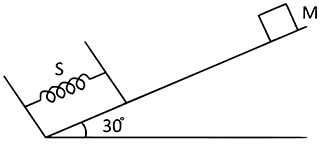
To find the speed of the mass just before it touches the spring, we begin by determining the spring constant, k, using Hooke's Law, where the force F is proportional to the compression x :F=kxGiven that a force of 100 N compresses the spring by 1 m , the spring constant k is calculated as:k=xF=1m100N=100N/mNext, we apply the principle of energy conservation. The initial potential and kinetic energy will equal the final potential energy stored in the compressed spring. The relevant energy conservation equation is:21mv2+mgh=21kxmax2where:m is the mass of the block ( 10 kg ),g is the acceleration due to gravity (10m/s2),h is the vertical height change, which is the same as the compression in this scenario ( xmax=2m ),v is the speed just before touching the spring,xmax is the maximum compression of the spring ( 2 m ).Rearranging the equation for v gives:v=mkxmax2−2ghSubstituting the known values:v=10kg(100N/m)(2m)2−2(10m/s2)22This simplifies to:v=10(100)(4)−40v=40−20=20m/sThus, the speed of the mass just before it touches the spring is 20m/s