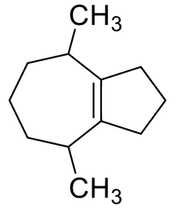
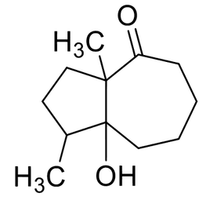
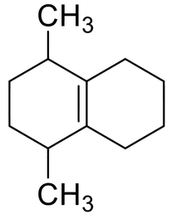
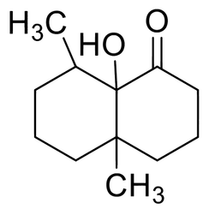
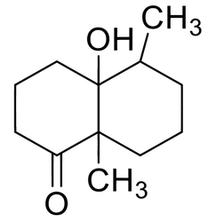
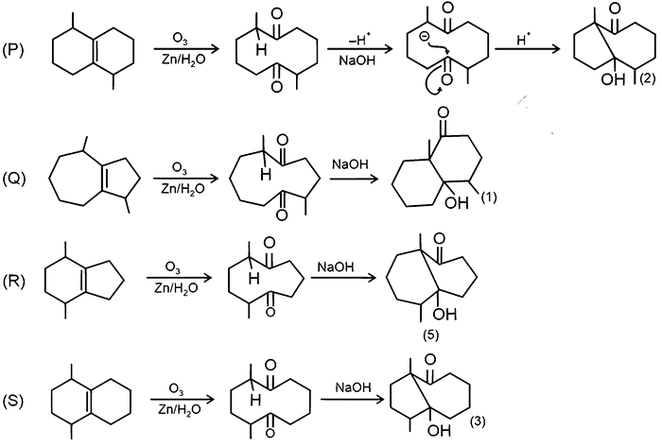
Concept:Ozonolysis cleaves each C=C bond to form a dicarbonyl compound.
Intramolecular aldol cyclization via the more stable enolate gives the product.
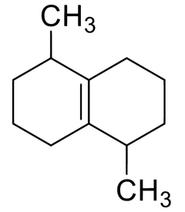
Explanation:Compound P is a cyclohexene derivative.
Ozonolysis with
O3/Zn–
H2O yields a 1,6-dicarbonyl compound.
Under aqueous
NaOH, the more stable enolate (conjugated or less sterically hindered) undergoes aldol cyclization to form a 5‑ or 6‑membered ring.
The product matches structure
3.
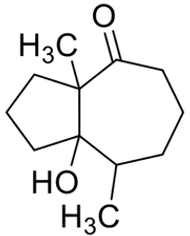
Compound Q undergoes ozonolysis to give a diketone with an appropriate distance between carbonyls.
Cyclization via the more stable enolate (often endocyclic) gives a bicyclic product corresponding to
4.
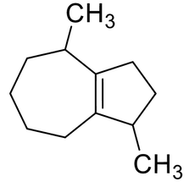
Compound R after ozonolysis and aldol reaction yields a product with a distinct ring system, identified as
5.
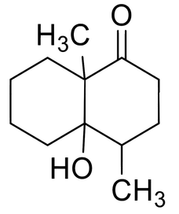
Compound S ozonolysis gives a dicarbonyl compound that undergoes cyclization to form product
2.
All cyclizations follow the principle of forming the most substituted enolate.
Answer:P → 3; Q → 4; R → 5; S → 2 (Option B).