Concept:Sugars are carbohydrates that exhibit specific reactions and optical properties.
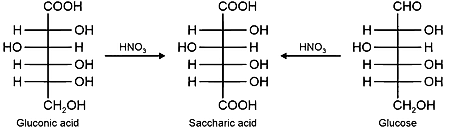
Explanation:Option (A):Glucose has both an aldehyde group (
−CHO) and a primary alcohol group (
−CH2OH).
Treatment with
HNO3 oxidizes both ends to
COOH, forming saccharic acid.
Gluconic acid has the aldehyde already oxidized to
COOH, so
HNO3 can still oxidize the
CH2OH end to
COOH, yielding saccharic acid.
Thus, both glucose and gluconic acid can be oxidized to saccharic acid by
HNO3.
The statement says glucose is NOT oxidized to saccharic acid, which is false.
Hence, Option (A) is incorrect.
Option (B):Fehling’s reagent contains a weak base (dilute
NaOH).
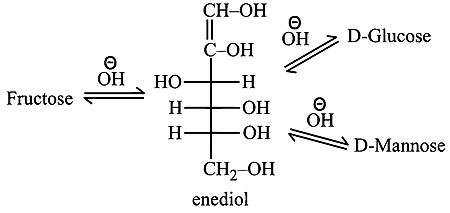
In basic medium, fructose undergoes tautomerization to form glucose and mannose (aldohexoses).
Glucose and mannose are reducing sugars and give a positive Fehling’s test.
Therefore, fructose also gives a positive Fehling’s test due to isomerization.
This statement is correct.
Option (C):Sucrose is a disaccharide of
D-glucose and
D-fructose.
Upon acid-catalyzed hydrolysis, sucrose breaks into an equimolar mixture of
D-glucose and
D-fructose.
This mixture is called invert sugar.
Thus, Option (C) is correct.
Option (D):Specific rotation of
D-glucose:
[α]=+52.5∘.
Specific rotation of
D-fructose:
[α]=−92.5∘.
For an equimolar mixture (invert sugar), the net specific rotation is the average:
[α]invert=2+52.5∘+(−92.5∘)=2−40∘=−20∘.The given value (
−40∘) is incorrect.
Hence, Option (D) is false.
Answer:The correct statements are (B) and (C).