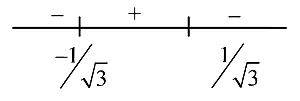
Concept:Solve the first-order linear differential equation to find f(x), then analyse its derivative and intersection with g(x).Explanation:The given differential equation is xdxdy=y−x3.Rewrite as xdy−ydx=−x3dx.Divide by x2: x2xdy−ydx=−xdx.The left side equals d(xy).Integrate: xy=−2x2+C.Multiply by x: y=−2x3+Cx.Use y(1)=0: 0=−21+C⇒C=21.Thus f(x)=2x−2x3.Differentiate: f′(x)=21−23x2=21(1−3x2).Critical points: x=±31. Only x=31 lies in (0,∞).For x<31, f′(x)>0; for x>31, f′(x)<0.Hence f has a local maximum at x=31 (option B true, A false).For x∈(1,2), f′(x) is negative (since 1>31), so f is decreasing – option C false.Now g(x)=4x3−5x2+23x.Solve f(x)=g(x): 2x−2x3=4x3−5x2+23x.Multiply by 2: x−x3=8x3−10x2+3x⇒0=9x3−10x2+2x.Factor: x(9x2−10x+2)=0.x=0 is not in (0,∞).Quadratic discriminant: Δ=100−72=28>0, roots x=95±7, both positive.Thus two solutions in (0,∞) – option D true.