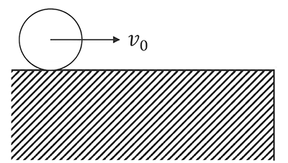
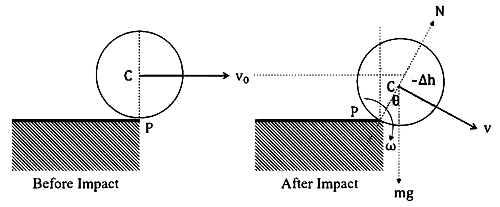
Concept:When the cylinder hits the corner, it pivots about that point, conserving angular momentum about the pivot. As it rotates upward, mechanical energy is conserved until the normal force becomes zero, marking loss of contact.Explanation:The cylinder initially rolls without slipping with speed v0=gR/3 and angular velocity ω0=v0/R.Moment of inertia about its centre: Icm=21MR2.About the pivot point P (distance R from centre), using parallel axis theorem: IP=Icm+MR2=23MR2.Just before impact, angular momentum about P: Linitial=Mv0R+Icmω0=23Mv0R.Just after impact, cylinder rotates about P with angular speed ω1: Lfinal=IPω1=23MR2ω1.Conservation of angular momentum gives ω1=v0/R.After pivoting, the centre of mass moves in a circle of radius R around P. Let θ be the angle the line PC makes with the vertical. Initial height of centre = R; at angle θ it is Rcosθ.Loss in potential energy: MgR(1−cosθ).By conservation of mechanical energy between start (θ=0, ω=ω1) and any θ (angular speed ω):21IPω2−21IPω12=MgR(1−cosθ).Substitute IP=23MR2 and ω1=v0/R: 43MR2ω2−43Mv02=MgR(1−cosθ).Using v=ωR: 43Mv2=43Mv02+MgR(1−cosθ).So v2=v02+34gR(1−cosθ). …(i)Radial forces on the centre of mass toward pivot: Mgcosθ−N=Mv2/R, where N is normal force from corner.At loss of contact, N=0: Mgcosθ=Mv2/R, so v2=gRcosθ. …(ii)From (i) and (ii): substitute cosθ=v2/(gR) into (i):v2=v02+34gR−34gR⋅gRv2=v02+34gR−34v2.Bring terms: v2+34v2=v02+34gR → 37v2=v02+34gR.Given v02=gR/3, so 37v2=3gR+34gR=35gR.Thus v2=75gR → v=75gR.