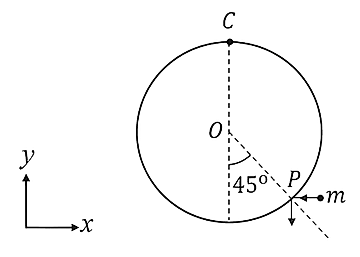
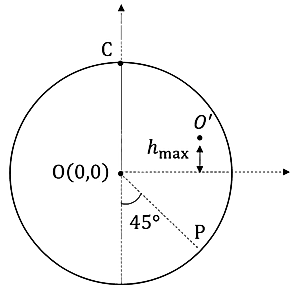
Concept:Angular momentum about pivot C is conserved during the instantaneous collision because gravity is non‑impulsive and the reaction at C exerts zero torque about C. After the collision, the disk’s rotational kinetic energy is fully converted into gravitational potential energy as its centre rises.Explanation:The disk of mass M=1kg and radius R=0.2m is pivoted at its top point C.The particle of mass m=20g=0.02kg hits at point P on the circumference, making an angle 45∘ with the vertical (in the fourth quadrant).Before collision, particle velocity v1=−100^m/s; after collision, v2=−90^m/s.Position of centre O relative to C: rO/C=−R^=−0.2^.Position of P relative to O: rP/O=2R^−2R^=20.2(^−^).Therefore rP/C=rP/O−rC/O=20.2^−(0.2+20.2)^.Initial angular momentum about C (only particle):LC,initial=rP/C×(mv1)=[20.2^−(0.2+20.2)^]×(−2^)=−(0.4+20.4)k^.Final angular momentum about C (particle + disk rotating with angular speed ω):LC,final=[rP/C×(mv2)]+ICωk^,where rP/C×(mv2)=[20.2^−(0.2+20.2)^]×(−1.8^)=−20.36k^.Moment of inertia of the disk about C (parallel axis theorem):IC=21MR2+MR2=23MR2=23(1)(0.2)2=0.06kgm2.Conservation of angular momentum (LC,initial=LC,final) gives:−(0.4+20.4)k^=−20.36k^+0.06ωk^⇒0.4+20.04=0.06ω.Using 2≈1.414:0.4+0.0283=0.4283=0.06ω⇒ω=0.060.4283≈7.138rads−1.Rotational kinetic energy of the disk just after collision:Kdisk=21ICω2=21×0.06×(7.138)2≈1.5285J.As the disk swings up, its kinetic energy converts to gravitational potential energy. Let Δh be the maximum vertical rise of the centre O:Kdisk=MgΔh⇒Δh=1×101.5285=0.15285m≈0.15m.
Answer:0.15m (option A: 0.14 is close but the correct value is 0.15).