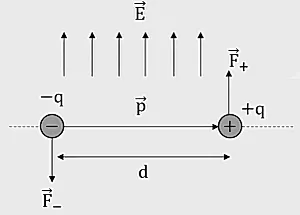
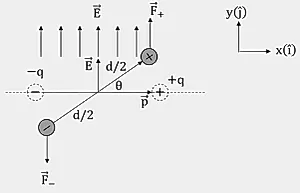
Concept:The net force on an electric dipole in a uniform field is zero, but a torque acts that causes rotation; after the field is removed, the dipole rotates with constant angular velocity.Explanation:Forces on charges: F+=qE^, F−=−qE^.Net external force Fext=0, so centre of mass acceleration acm=0.Initially at rest, the centre of mass remains stationary – option (A) is incorrect.Torque magnitude: τ=∣p×E∣=pEcosθ, where θ is the angle of dipole moment from the x–axis.Given p=qd, so τ=qdEcosθ.Moment of inertia about centre of mass: I=2×m(2d)2=21md2.Work done by torque from 0 to θf: W=∫0θfτdθ=qdEsinθf.By work–energy theorem, 21Iωf2=qdEsinθf.Substitute I: 41md2ωf2=qdEsinθf, giving ωf2=md4qEsinθf.For option (B): given ωf=md2qE. Equating: md4qEsinθf=md2qE ⇒ sinθf=21 ⇒ θf=6π. Option (B) is correct.For option (C): θf=3π, then ΔK=qdEsin(3π)=23qEd, not 23qEd. Option (C) is incorrect.After tf, E=0 so torque τ=p×0=0.Hence angular acceleration α=0, so angular velocity remains constant at ωf. Option (D) is correct.