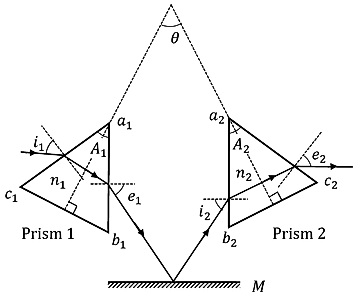
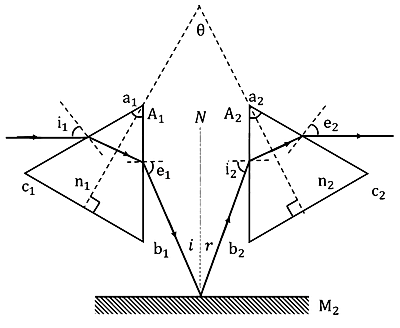
Concept:The geometry of the parallel vertical faces and the mirror forces the angle of emergence from prism 1 to equal the angle of incidence on prism 2.
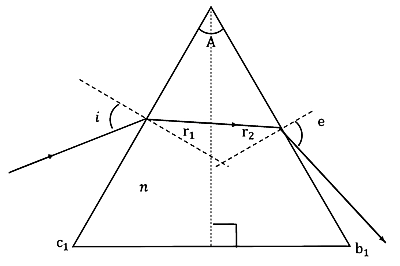
Explanation:At minimum deviation for a prism,
r=2A and Snell’s law gives
sini=nsin2A.
Faces
a1b1 and
a2b2 are vertical and parallel, and perpendicular to the horizontal mirror
M.
The ray emerges from prism 1 at angle
e1 (with horizontal), reflects off
M (angle unchanged), and enters prism 2 at the same angle, so
i2=e1.
If both prisms are at minimum deviation:
sine1=n1sin2A1 and
sini2=n2sin2A2.
Since
sini2=sine1, we get
n1sin2A1=n2sin2A2, i.e.
n1n2=sin(A2/2)sin(A1/2). Hence option A is correct.
If only prism 2 is at minimum deviation,
sini2=n2sin2A2 but
i2=e1 depends on prism 1;
sini1 does not equal that expression generally. Option B is false.
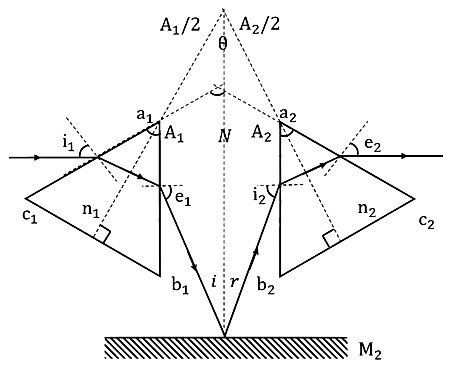
For thin prisms (
A≪1),
δm=(n−1)A so
A=n−1δm. The angle
θ between outer faces is
2A1+2A2. Substituting gives
θ=2(n1−1)δm1+2(n2−1)δm2. Option C is correct.
If only prism 1 is at minimum deviation,
sine1=n1sin2A1 and
i2=e1, so
sini2=n1sin2A1 holds always. Option D is correct.
Answer:Options A, C, D are correct.