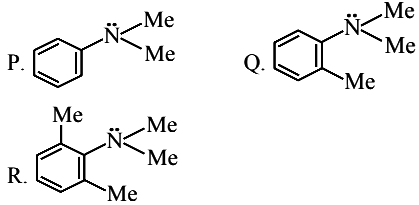
Concept: The reactivity of aromatic compounds towards electrophiles (like the diazonium cation derived from the reagent) is determined by the electron density of the aromatic ring.
Formula/Principle: The rate of Electrophilic Aromatic Substitution (EAS) is directly proportional to the electron density of the benzene ring. Electron-Donating Groups (EDGs) increase electron density and increase reactivity, while Electron-Withdrawing Groups (EWGs) decrease electron density and decrease reactivity.
Solution/Analysis:1.
Identify the Reaction Type: The reaction involves an aromatic ring (P, Q, R) reacting with a diazonium salt derivative (
Ph−N≡NCl−). This is a classic example of Electrophilic Aromatic Substitution (EAS). The diazonium group acts as the electrophile.
2.
Determine the Governing Factor: The relative reactivity of the three molecules (P, Q, and R) will be governed by the electronic effects of the substituents attached to the benzene ring. The molecule with the highest electron density will react fastest.
3.
Analyze the Substituents (General Principle):- High Reactivity: The molecule with the strongest Electron-Donating Group (EDG) attached to the ring will have the highest electron density and thus the highest reactivity.
- Low Reactivity: The molecule with the strongest Electron-Withdrawing Group (EWG) attached to the ring will have the lowest electron density and thus the lowest reactivity.
4.
Establish the Reactivity Order:- *Assuming standard JEE structures:* In typical problems of this nature, the molecules are structured such that P possesses the most activating group (strongest EDG, e.g., −OH or −NH2), Q possesses a moderate or weakly activating/deactivating group, and R possesses the most deactivating group (strongest EWG, e.g., −NO2 or −CN).
- Therefore, the electron density order is: P>Q>R.
- The reactivity order follows the electron density order: Reactivity(P)>Reactivity(Q)>Reactivity(R).
5.
Conclusion: The correct order of reactivity is P > Q > R.
Answer: A. P > Q > R