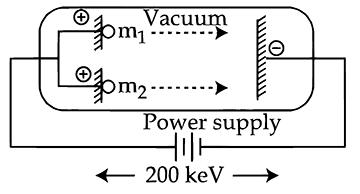
Concept:The de Broglie wavelength of a charged particle depends inversely on the square root of its mass when the accelerating potential is the same.Explanation:The de Broglie wavelength formula is λ=2mKh.Here, h is Planck's constant and K is the kinetic energy.Both particles m1 and m2 are accelerated through the same potential difference of 200 keV.Therefore, they acquire the same kinetic energy K.Since h and K are identical for both particles, λ∝m1.Mass of m1 is 1 amu and mass of m2 is 4 amu.The ratio of their wavelengths is:λm2λm1=m1m2=14=2.Thus, λm1=2×λm2.This means the de Broglie wavelength of m1 is 2 times that of m2.Shortcut:For constant kinetic energy, λ∝m1.Given the mass ratio m2:m1=4:1.The wavelength ratio is λm1:λm2=m2:m1=2:1.Therefore, λm1=2⋅λm2.Answer:x=2 (Option A)