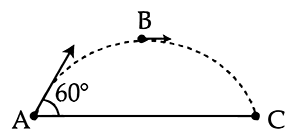
Concept:At the highest point, vertical velocity becomes zero, and horizontal velocity remains constant.
Kinetic energy at the same horizontal level equals initial kinetic energy due to conservation of mechanical energy.
Explanation:Initial kinetic energy at point A:
KA=K=21mu2.
Angle of projection:
θ=60∘.
At point B (maximum height), the horizontal velocity is
vB=ucos60∘=2u.
Thus,
KB=21m(2u)2=41(21mu2)=4K.
At point C (same level as A), the speed equals the initial speed:
vC=u, so
KC=K (conservation of energy).
Difference in kinetic energies between B and C:
ΔKBC=∣KC−KB∣=K−4K=43K.
Required ratio =
KAΔKBC=K3K/4=43.
Answer:The ratio is
3:4, which corresponds to option A.