Exams Net
Unrestricted Exams Practice
Home
Exams
Banking
CUET
Defence
Engineering
Finance
GATE
Insurance
International
JEE
LAW
MBA
MCA
Medical
Other
Police
PSC
RRB
SSC
State Govt
Subjectwise
Teacher
SET Exams
UPSC
Aptitude
Algebra and Higher Mathematics
Arithmetic
Commercial Mathematics
Data Based Mathematics
Geometry and Mensuration
Number System and Numeracy
Problem Solving
Board Exams
Andhra
Bihar
CBSE
Gujarat
Haryana
ICSE
Jammu and Kashmir
Karnataka
Kerala
Madhya Pradesh
Maharashtra
Odisha
Tamil Nadu
Telangana
Uttar Pradesh
English
Competitive English
CBSE
CBSE Class 10 Solutions
CBSE Class 12 Solutions
CBSE Question Papers (Pdf)
NCERT Books (Pdf)
NCERT Exemplar Books (Pdf)
NCERT Study Notes (Pdf)
CBSE Study Concepts (Pdf)
NCERT Text Book Class 11 Solutions
NCERT Text Book Class 12 Solutions
ICSE Class 10 Papers
Certifications
Technical
Cloud Tech Certifications
Security Tech Certifications
Management
IT Infrastructure
More
About
Contact Us
Our Apps
Privacy
+
-
Test Index
JEE Mains 05 Sep 2020 Shift 2 Solved Paper
Show Para
Hide Para
Section:
Physics
Share question:
© examsnet.com
Question : 5 of 75
Marks:
+1
,
-0
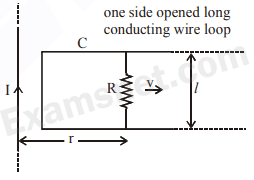
An infinitely long straight wire carrying current I, one side opened rectangular loop and a conductor
C
C
C
with a sliding connector are located in the same plane, as shown in the figure. The connector has length
l
l
l
and resistance
R
R
R
. It slides to the right with a velocity v. The resistance of the conductor and the self inductance of the loop are negligible. The induced current in the loop, as a function of separation
r
,
r,
r
,
between the connector and the straight wire is :
[5 Sep 2020 Shift 2]
μ
0
π
I
v
l
R
r
\frac{\mu_{0}}{\pi} \frac{I v l}{R r}
π
μ
0
R
r
I
v
l
μ
0
2
π
I
v
l
R
r
\frac{\mu_{0}}{2\pi} \frac{I v l}{R r}
2
π
μ
0
R
r
I
v
l
2
μ
0
π
I
v
l
R
r
\frac{2\mu_{0}}{\pi} \frac{I v l}{R r}
π
2
μ
0
R
r
I
v
l
μ
0
4
π
I
v
l
R
r
\frac{\mu_{0}}{4\pi} \frac{I v l}{R r}
4
π
μ
0
R
r
I
v
l
Validate
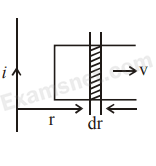
Solution:
B
=
μ
0
i
2
π
r
B = \frac{\mu_{0} i}{2 \pi r}
B
=
2
π
r
μ
0
i
ϕ
=
μ
0
i
2
π
r
l
d
r
\phi = \frac{\mu_{0} i}{2 \pi r} l dr
ϕ
=
2
π
r
μ
0
i
l
d
r
⇒
d
ϕ
d
t
=
μ
0
i
l
2
π
r
⋅
d
r
d
t
\Rightarrow \frac{d\phi}{dt} = \frac{\mu_{0} i l}{2 \pi r} \cdot \frac{dr}{dt}
⇒
d
t
d
ϕ
=
2
π
r
μ
0
i
l
⋅
d
t
d
r
⇒
e
=
μ
0
2
π
⋅
i
v
l
r
\Rightarrow e = \frac{\mu_{0}}{2 \pi} \cdot \frac{i v l}{r}
⇒
e
=
2
π
μ
0
⋅
r
i
v
l
i
=
e
R
=
μ
0
2
π
⋅
i
v
l
R
r
i = \frac{e}{R} = \frac{\mu_{0}}{2 \pi} \cdot \frac{i v l}{R r}
i
=
R
e
=
2
π
μ
0
⋅
R
r
i
v
l
© examsnet.com
Go to Question:
1
2
3
4
5
6
7
8
9
10
11
12
13
14
15
16
17
18
19
20
21
22
23
24
25
26
27
28
29
30
31
32
33
34
35
36
37
38
39
40
41
42
43
44
45
46
47
48
49
50
51
52
53
54
55
56
57
58
59
60
61
62
63
64
65
66
67
68
69
70
71
72
73
74
75
Prev Question
Next Question
More Free Exams
AIEEE Previous Papers
BITSAT Exam Previous Papers
JEE Adv
JEE Advanced Model Papers
JEE Advanced Previous Papers
JEE Main
JEE Mains Model Papers
VITEEE Previous Papers