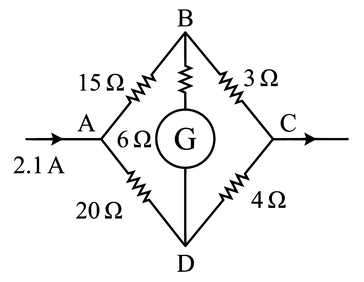
Concept:A balanced Wheatstone bridge carries no current through the middle branch resistor, so the circuit simplifies into two parallel branches.
Explanation:The bridge arms are
RAB=15 Ω,
RBC=3 Ω,
RAD=20 Ω, and
RDC=4 Ω, with a
6 Ω resistor between
B and
D.
Check the balance condition:
RBCRAB=315=5RDCRAD=420=5Since both ratios are equal, the bridge is balanced.
Hence, no current flows through the
6 Ω resistor, so that branch can be removed.
The circuit now consists of two parallel branches.
Resistance of the upper branch:
R1=15+3=18 ΩResistance of the lower branch:
R2=20+4=24 ΩThe total current supplied is
I=2.1 A.
The
15 Ω resistor is in the upper branch, so apply the current divider rule:
I15Ω=I×R1+R2R2Substitute the values:
I15Ω=2.1×18+2424=2.1×4224=1.2 AAnswer:The current flowing through the
15 Ω resistance is
1.2 A, which corresponds to option C.