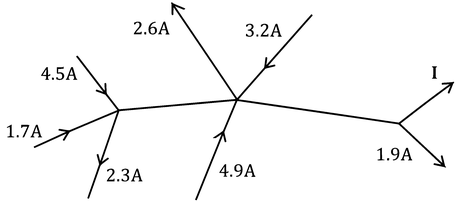
Concept:By Kirchhoff's Current Law, the total current entering a junction is exactly equal to the total current leaving that junction. This principle is used step by step to find the unknown current
I.
Explanation:Let the three junctions from left to right be labelled as
J1,
J2, and
J3.
At junction
J1, the currents entering are
4.5 A and
1.7 A, while the currents leaving are
2.3 A and
I1.
Applying KCL at
J1:
4.5+1.7=2.3+I1I1=6.2−2.3=3.9 ASo, the current flowing from
J1 to
J2 is
3.9 A.
At junction
J2, the entering currents are
I1,
3.2 A, and
4.9 A, while the leaving currents are
2.6 A and
I2.
Applying KCL at
J2:
I1+3.2+4.9=2.6+I23.9+3.2+4.9=12.0=2.6+I2I2=12.0−2.6=9.4 AThus, the current reaching junction
J3 is
9.4 A.
At junction
J3, the entering current is
I2, and the leaving currents are
1.9 A and
I.
Applying KCL at
J3:
I2=1.9+I9.4=1.9+II=9.4−1.9=7.5 AHence, the required current
I is obtained.
Answer:I=7.5 A, so the correct option is D.