Concept:Doping germanium with a group 13 element forms a p-type semiconductor, while doping with a group 15 element forms an n-type semiconductor.
Explanation:Germanium (
Ge) has
Z=32, so it belongs to group 14 and has 4 valence electrons.
Indium (
In) has
Z=49.
It belongs to group 13 and has 3 valence electrons.
Doping
Ge with
In creates acceptor atoms, producing holes as majority charge carriers.
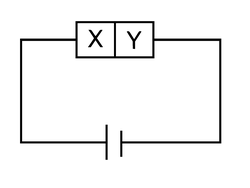
Therefore, semiconductor X is p-type.
Arsenic (
As) has
Z=33.
It belongs to group 15 and has 5 valence electrons.
Doping
Ge with
As creates donor atoms, providing excess electrons as majority charge carriers.
Therefore, semiconductor Y is n-type.
In the given circuit, the p-side X is connected to the negative terminal of the battery.
The n-side Y is connected to the positive terminal of the battery.
For a p-n junction, forward bias occurs when the p-side is positive and the n-side is negative.
Reverse bias occurs when the p-side is negative and the n-side is positive.
Since the p-side is negative and the n-side is positive, the junction is reverse biased.
Answer:Option B:
X is p-type,
Y is n-type, and the junction is reverse biased.