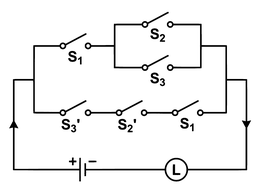
Concept:Convert the switching circuit into a Boolean expression, then simplify it using laws of Boolean algebra.
Explanation:Let
p,q,r represent switches
S1,S2,S3 respectively.
In the upper branch,
S1 is in series with the parallel combination of
S2 and
S3, giving
p∧(q∨r).
In the lower branch,
S1 is in series with not
S2 and not
S3, giving
p∧(∼q∧∼r).
Since the branches are in parallel, combine them using OR:
[p∧(q∨r)]∨[p∧(∼q∧∼r)]Using De Morgan's law,
∼q∧∼r=∼(q∨r).
So the expression becomes:
[p∧(q∨r)]∨[p∧∼(q∨r)]Since
p is common, factor it out:
p∧[(q∨r)∨∼(q∨r)]Now
(q∨r) and its negation
∼(q∨r) are complementary, so their OR is always true:
(q∨r)∨∼(q∨r)=TTherefore:
p∧T=pSo the entire circuit is equivalent to only switch
S1.
Answer:The simplified switching circuit is equivalent to a single switch
S1.
Select the option that shows only switch
S1 in the circuit.