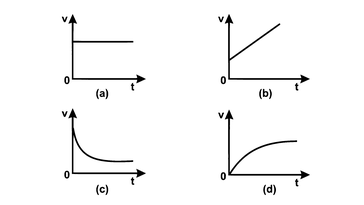
Concept:When a metal sphere falls through a viscous liquid, its velocity increases exponentially and approaches a constant terminal velocity, so the
v–
t graph starts steep and gradually flattens.
Explanation:Three forces act on the sphere: weight
mg downward, buoyant force
FB=34πr3σg upward, and viscous drag
Fv=6πηrv upward.
The equation of motion is:
mdtdv=mg−34πr3σg−6πηrvAt
t=0, the velocity
v=0, so the viscous drag is zero. Hence, the net downward force is maximum and the initial acceleration is maximum.
As the sphere speeds up, the viscous drag
6πηrv increases linearly with
v, reducing the net downward force. Therefore, the acceleration decreases continuously, and the slope of the
v–
t graph keeps decreasing.
When the drag force equals the effective weight, the net force becomes zero and the sphere attains a constant terminal velocity
vT.
The velocity variation is given by:
v=vT(1−e−kt/m),k=6πηrThis curve starts from the origin, rises rapidly, and then gradually levels off toward
vT. Among the given graphs, graph (d) shows exactly this behaviour.
Answer:Option C: graph (d).