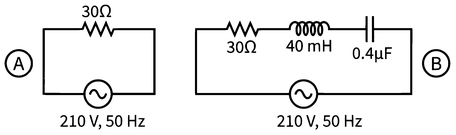
Concept:For a pure resistive circuit, impedance is just resistance. For a series LCR circuit, impedance is always greater than or equal to resistance.
Explanation:For circuit (A), there is no inductor or capacitor, so its impedance is
ZA​=R=30 Ω.
The r.m.s. current in circuit (A) is
IA​=ZA​Vrms​​=RVrms​​.
For circuit (B), which is a series LCR circuit, impedance is given by
ZB​=R2+(XL​−XC​)2​.
Since
(XL​−XC​)2≥0, we get
ZB​≥R.
Thus,
ZB​≥ZA​.
Both circuits are connected to the same supply voltage
Vrms​.
Current is inversely proportional to impedance, so
IB​=ZB​Vrms​​ and
IA​=ZA​Vrms​​.
Because
ZB​≥ZA​, it follows that
IB​≤IA​.
At resonance,
XL​=XC​, so
ZB​=R and therefore
IB​=IA​.
In all other cases,
ZB​>R, giving
IB​<IA​.
Hence, the r.m.s. current in circuit (B) can never be larger than that in circuit (A).
Answer:Option D: The r.m.s. current in (B) can never be larger than that in (A).