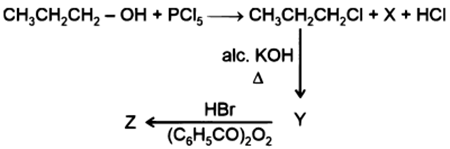
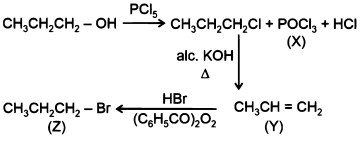
Concept:The reaction sequence involves converting an alcohol into an alkyl halide via chlorination with POCl3, followed by nucleophilic substitution to give propyl bromide.Chemical Equation / Formula:Alcohol chlorination: R−OH+POCl3→R−Cl+H3PO3.Bromination: R−Cl+Br−SN2R−Br+Cl−.Explanation:Step 1: The starting alcohol (likely propanol) reacts with POCl3 to form the corresponding chloroalkane and phosphorous acid (H3PO3). Thus, X is POCl3.Step 2: The chloroalkane undergoes SN2 displacement with a bromide ion (e.g., from NaBr or KBr) to yield the bromoalkane. Therefore, Z is CH3CH2CH2Br (propyl bromide).No other reagent among the options produces the correct bromo product under these conditions.Shortcut:Recall that POCl3 is a common reagent for converting alcohols to alkyl chlorides. The subsequent halogen exchange with Br− gives the corresponding bromide.