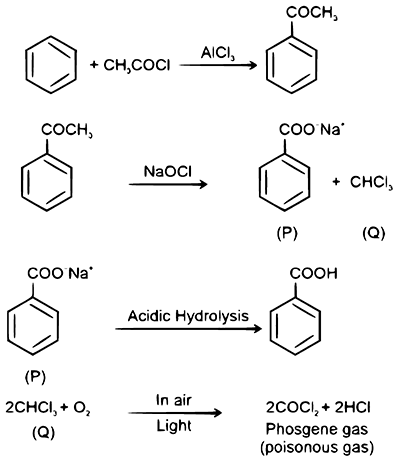
Concept:The reaction sequence is the haloform reaction, where a methyl ketone reacts with halogen in base to give a sodium salt of a carboxylic acid (P) and a haloform (Q).
Explanation:Step 1: In the haloform reaction, a compound containing the
CH3CO− group reacts with
NaOX (or
X2 + base) to produce P (e.g.,
RCOONa) and Q (e.g.,
CHCl3 or
CHI3).
Step 2: When P is acidified, it forms the corresponding carboxylic acid (
RCOOH).
Step 3: Q, especially chloroform (
CHCl3), slowly oxidizes to phosgene (
COCl2) on exposure to air and light, which is a highly poisonous gas.
Step 4: Option A is false because P is a salt, not a carbonyl compound, and Q is a haloform, not a carbonyl.
Step 5: Option B is false because Q is a haloform, not a primary alcohol.
Step 6: Option C is false because P and Q need not be aromatic; they can be aliphatic.
Step 7: Only option D correctly describes the chemical properties of P and Q in this sequence.
Answer:The correct option is D.