Concept:The order of a reaction is identified by which function of concentration gives a straight line against time.
A straight line for
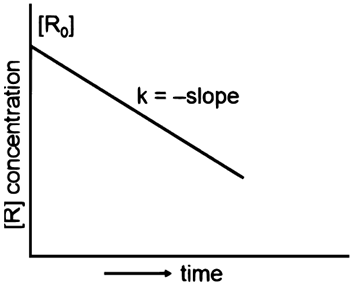
[R] itself versus time means the rate is independent of concentration, i.e. zero order.
Formula / Integrated rate laws:Zero order:
[R]=[R]0−kt, so the plot of
[R] vs
t is linear with slope
=−k (hence
k=−slope).
First order:
ln[R]=ln[R]0−kt, so
ln[R] vs
t is linear.
Second order:
[R]1=[R]01+kt, so
1/[R] vs
t is linear.
Explanation:The given graph is a plot of
[R] vs time, and it is a straight line falling with a constant negative slope.
A constant negative slope means the rate,
−dtd[R], remains constant throughout the reaction.
A constant rate,
rate=k[R]0=k, is the defining characteristic of a zero-order reaction.
The label
k=−slope written on the graph also corresponds exactly to
[R]=[R]0−kt, the zero-order equation.
If the reaction were first or second order,
[R] vs
t would be curved (exponential fall), and only
ln[R] vs
t or
1/[R] vs
t would be linear.
Therefore the order of the reaction is
0.
Answer:A. 0 (zero order)