Concept:Negative deviation from Raoult's law occurs when the intermolecular forces between unlike molecules (A–B) in the mixture are stronger than those between like molecules (A–A and B–B) in the pure components.
Stronger A–B attractions hold the molecules more tightly, so the escaping tendency of each component decreases.
Hence the vapour pressure of the solution falls below the value predicted by Raoult's law.
Chemical Formula:Acetone:
CH3COCH3Chloroform:
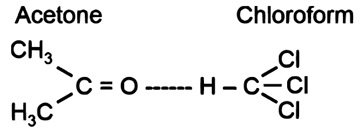
CHCl3Hydrogen bond formed:
CHCl3⋯O=C(CH3)2.
Explanation:The oxygen atom of the acetone carbonyl group has lone pairs and acts as a hydrogen bond acceptor.
The hydrogen atom of chloroform is partially positive because the three chlorine atoms withdraw electron density strongly, so it acts as a hydrogen bond donor.
Thus a strong intermolecular hydrogen bond forms between the H of chloroform and the O of acetone.
This new
O⋯H interaction is stronger than the dipole–dipole forces present in pure acetone and the weak forces present in pure chloroform.
Because the molecules in the mixture are held together more firmly, their escaping tendency into the vapour phase decreases.
Consequently, the vapour pressure of the mixture is lower than that expected from Raoult's law, which is exactly the characteristic of a negative deviation.
As a result, the mixture shows a maximum boiling azeotrope.
Option B is therefore the correct choice, since it correctly identifies the formation of hydrogen bonding between acetone and chloroform molecules as the cause.
Answer:Option B.