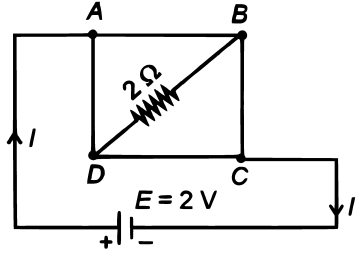
Concept:The four sides of the square loop act as the four arms of a Wheatstone bridge, and the
2Ω resistor between
B and
D is the bridge arm.
Solution:The uniform wire has total resistance
4Ω, so each side of the square has resistance
44=1Ω.
Hence
RAB=RBC=RCD=RDA=1Ω.
The battery is connected across
A and
C, and the
2Ω resistor is connected between
B and
D.
Bridge balance condition:
RBCRAB=11=1 and
RDCRAD=11=1.
The two ratios are equal, so the bridge is balanced.
Equivalently, the circuit is symmetric about the line
AC, so
VB=VD.
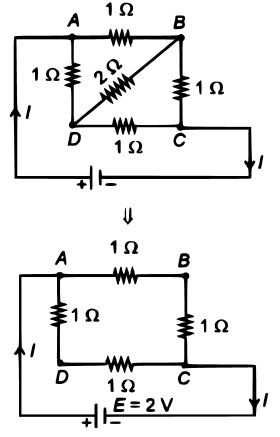
Therefore no current flows through the
2Ω resistor and it can be removed from the circuit.
The circuit between
A and
C then reduces to two parallel branches:
Branch
A→B→C:
1Ω+1Ω=2Ω.
Branch
A→D→C:
1Ω+1Ω=2Ω.
Reff=2+22×2=1ΩUsing Ohm's law,
I=ReffV=1Ω2V=2A.
Shortcut:In a balanced Wheatstone bridge, delete the bridge resistor (
2Ω); the two
2Ω arms in parallel give
Reff=1Ω, so
I=1Ω2V=2A.
Answer:2A (Option A)