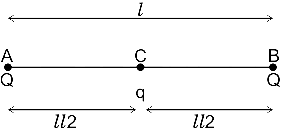
Concept:For equilibrium of the system, the net force on every charge must be zero.
The charge
q must be negative so that it attracts the two outer charges
Q and balances their mutual repulsion.
Explanation:Let the two equal charges
Q be placed at points A and B, with distance
l between them.
The charge
q is at the midpoint C, so
AC=BC=2l.
Consider the equilibrium of the charge
Q at A.
The repulsive force on A due to the other charge
Q at B is:
FAB=Kl2Q2The force on A due to charge
q at C is:
FAC=K(2l)2Qq=Kl24QqFor equilibrium, these forces must be equal in magnitude and opposite in direction.
Since
FAB is repulsive,
FAC must be attractive, so
q must be negative.
Equating magnitudes:
Kl24Q∣q∣=Kl2Q24∣q∣=Q∣q∣=4QHence,
q=−4Q.
The central charge
q also experiences equal and opposite forces from the two charges
Q, so it is already in equilibrium.
Answer:Option B:
−4Q