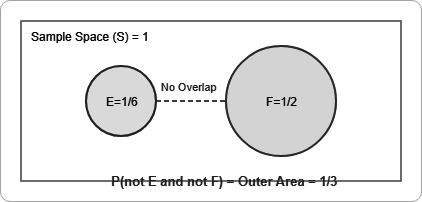
Concept:For mutually exclusive events,
P(E∩F)=0, and
P(not E and not F) is the complement of the union
P(E∪F).
Explanation:Since E and F are mutually exclusive, they cannot occur together, so
P(E∩F)=0.
Using the addition theorem:
P(E∪F)=P(E)+P(F)−P(E∩F).
Substitute the given values:
P(E∪F)=61+21−0.
Convert to like fractions:
P(E∪F)=61+63=64=32.
Now,
P(not E and not F)=P(E′∩F′).
By De Morgan's law,
P(E′∩F′)=1−P(E∪F).
Therefore,
P(not E and not F)=1−32=31.
Answer:The required probability is
31, which matches option D.