Concept:Check whether each statement alone gives a unique arrangement of A, B, C, D and E around the circular table.
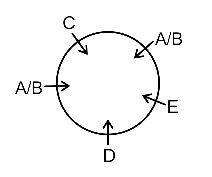
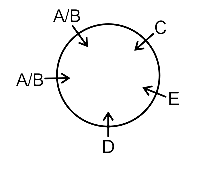
Explanation:From Statement (I), only one person sits between D and C, and E sits to the immediate right of D.
Since the position of C with respect to D is not fixed, two different arrangements are possible.
Also the positions of A and B are not fixed in either arrangement.
Therefore, the person to the immediate right of A cannot be determined from Statement (I) alone.
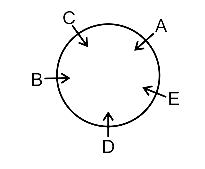
Now take Statement (II): B sits to the immediate left of D.
Only one person sits between B and E, and only one person sits between E and C.
Fix D at position 1, so B is at position 2.
With one person between B and E, E is placed at position 5.
With one person between E and C, C is placed at position 3.
Thus A is at the remaining position 4.
As all are facing the centre, the immediate right of A is the person at position 3, which is C.
So Statement (II) alone gives a definite answer.
Answer:Data in Statement II alone is sufficient to answer the question while data in Statement I is not.
Hence, Option D is correct.