Exams Net
Unrestricted Exams Practice
Home
Exams
Banking
CUET
Defence
Engineering
Finance
GATE
Insurance
International
JEE
LAW
MBA
MCA
Medical
Other
Police
PSC
RRB
SSC
State Govt
Subjectwise
Teacher
SET Exams
UPSC
Aptitude
Algebra and Higher Mathematics
Arithmetic
Commercial Mathematics
Data Based Mathematics
Geometry and Mensuration
Number System and Numeracy
Problem Solving
Board Exams
Andhra
Bihar
CBSE
Gujarat
Haryana
ICSE
Jammu and Kashmir
Karnataka
Kerala
Madhya Pradesh
Maharashtra
Odisha
Tamil Nadu
Telangana
Uttar Pradesh
English
Competitive English
CBSE
CBSE Class 10 Solutions
CBSE Class 12 Solutions
CBSE Question Papers (Pdf)
NCERT Books (Pdf)
NCERT Exemplar Books (Pdf)
NCERT Study Notes (Pdf)
CBSE Study Concepts (Pdf)
NCERT Text Book Class 11 Solutions
NCERT Text Book Class 12 Solutions
ICSE Class 10 Papers
Certifications
Technical
Cloud Tech Certifications
Security Tech Certifications
Management
IT Infrastructure
More
About
Contact Us
Our Apps
Privacy
+
-
Default
Dark
Blue
Green
Violet
Crimson
Red
Cafe
Gold
Orange
Olive
Grey
Test Index
SAT Mathematics Practice Test 2
Show Para
Hide Para
Share question:
© examsnet.com
Question : 47 of 58
Marks:
+1
,
-0
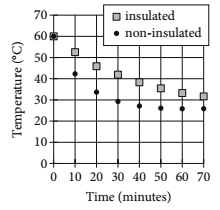
Two samples of water of equal mass are heated to 60 degrees Celsius (°C). One sample is poured into an insulated container, and the other sample is poured into a non-insulated container. The samples are then left for 70 minutes to cool in a room having a temperature of 25°C. The graph above shows the temperature of each sample at 10-minute intervals. Which of the following statements correctly compares the average rates at which the temperatures of the two samples change?
In every 10-minute interval, the magnitude of the rate of change of temperature of the insulated sample is greater than that of the non-insulated sample.
In every 10-minute interval, the magnitude of the rate of change of temperature of the non-insulated sample is greater than that of the insulated sample.
In the intervals from 0 to 10 minutes and from 10 to 20 minutes, the rates of change of temperature of the insulated sample are of greater magnitude, whereas in the intervals from 40 to 50 minutes and from 50 to 60 minutes, the rates of change of temperature of the non-insulated sample are of greater magnitude.
In the intervals from 0 to 10 minutes and from10 to 20 minutes, the rates of change of temperature of the non-insulated sample are of greater magnitude, whereas in the intervals from 40 to 50 minutes and from 50 to 60 minutes, the rates of change of temperature of the insulated sample are of greater magnitude.
Validate
Go to Question:
1
2
3
4
5
6
7
8
9
10
11
12
13
14
15
16
17
18
19
20
21
22
23
24
25
26
27
28
29
30
31
32
33
34
35
36
37
38
39
40
41
42
43
44
45
46
47
48
49
50
51
52
53
54
55
56
57
58
Prev Question
Next Question