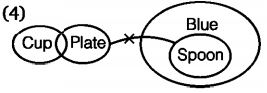
Concept:In syllogism, a conclusion must follow necessarily from the given statements.
Explanation:From "Some cups are plates" and "No plates are spoon", the cups that are plates cannot be spoons.
So conclusion I ("Some cups are not spoon") follows.
"All spoons are blue" gives "Some blue are spoons".
Since no plate is a spoon, those blue spoons are not plates.
So conclusion IV ("Some blue are not plates") follows.
Conclusion II ("Some plates are not blue") does not follow because plates can be blue without being spoons.
Conclusion III ("Some cups are not blue") does not follow because the cups that are plates may still be blue.
Answer:Only conclusions I and IV follow.