Concept:In simple harmonic motion, two instants have the same phase when the particle has identical displacement and the same direction of velocity (including zero velocity at extremes).
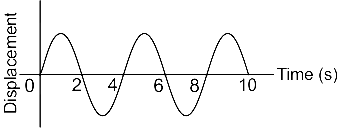
Explanation:From the displacement‑time graph, the time period is
4 seconds.
At
t=1 s, displacement is positive maximum; at
t=3 s, displacement is negative maximum — these are opposite extremes, so the phase difference is
Ï€ radians.
At
t=2 s, the particle is at the mean position moving downward; at
t=8 s, it is also at the mean position but moving upward — directions are opposite, so phases differ.
At
t=3 s and
t=7 s, both are at the negative extreme; the particle is momentarily at rest at the same point, so displacement and direction (zero velocity) are identical — hence the phase is the same.
At
t=4 s, the particle is at the mean position moving upward; at
t=10 s, it is at the mean position moving downward — directions differ, so phases are different.
Thus, only the pair
(3Â s,7Â s) has the same phase.
Answer:C. Phase of the oscillating particle is same at
t=3 s and
t=7 s.