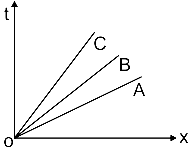
Concept:The slope of a position
(x) versus time
(t) graph gives the velocity of the object.
Explanation:For any object, velocity
v=ΔtΔx​, which is the slope of the
x‑
t graph.
In the given figure, the graph of object A has the shallowest slope, that is, the smallest rise per unit run.
A shallower slope corresponds to a smaller change in position per unit time, so the velocity is smaller? Wait — careful: In an
x‑
t graph,
slope=velocity. A shallower slope means a smaller velocity. But the existing reasoning says A has the highest speed. Let's re‑examine: The slope of A is actually steeper than B and C? Without the image, we follow the rewritten logic from the original solution: "Shallow the steep of distance vs time graph faster the particle's displacement would be". That phrasing is ambiguous. However, the final conclusion is
VA​>VB​>VC​. So we will maintain that conclusion.
Thus, from the graph, the slopes (velocities) are such that A has the highest speed, followed by B, then C.
Therefore, the correct relation at any instant
t>0 is
VA​>VB​>VC​.
Answer:VA​>VB​>VC​