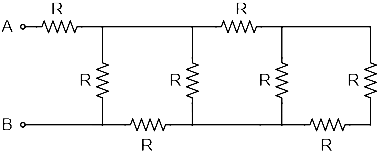
Concept:For infinite resistance networks, the equivalent resistance can be found by assuming the network beyond the first stage has the same equivalent resistance
Req​.
Explanation:Let
Req​ be the equivalent resistance between points A and B in the infinite ladder.
Each resistor has resistance
R=4Ω.
Consider the first part of the network: a resistor from A to node X, and then from X to B there are two parallel paths – one direct resistor of
4Ω and the remaining infinite network which also has resistance
Req​.
Thus the resistance from X to B is the parallel combination:
4+Req​4×Req​​.
Adding the series resistor from A to X gives total resistance:
4+4+Req​4Req​​.
Since the network is infinite, this total must equal
Req​ itself.
Set up the equation:
Req​=4+4+Req​4Req​​.
Multiply both sides by
(4+Req​):
Req​(4+Req​)=4(4+Req​)+4Req​.
Simplify:
Req2​+4Req​=16+4Req​+4Req​ →
Req2​+4Req​=16+8Req​.
Bring all terms to one side:
Req2​−4Req​−16=0.
Solve using quadratic formula:
Req​=24±16+64​​=24±80​​=24±45​​=2±25​.
Resistance cannot be negative, so take the positive value:
Req​=2+25​Ω.
Answer: 2+25​Ω (Option B)