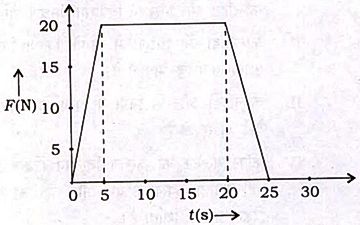
1. Concept:The area under a force-time (
F−t) graph gives the impulse, which is equal to the change in momentum of the object (
Δp=mΔv).
2. Explanation:• The shape of the graph is a trapezium. We can calculate its area to find the total impulse.
• The parallel sides of the trapezium are the base (from
t=0 to
t=25) and the top side (from
t=5 to
t=20).
• Length of the base =
25−0=25 s• Length of the top side =
20−5=15 s• Height of the trapezium =
20 N• Calculate the area (Impulse):
Area=21​×(sum of parallel sides)×heightArea=21​×(25+15)×20=21​×40×20=400 N s• The change in momentum is
Δp=400 kg m/s.
• Using the relation
Δp=m(vf​−vi​) and assuming the object starts from rest (
vi​=0):
400=10×vf​vf​=10400​=40 m/s3. Answer:40 m/s