Test Index
CBSE Class 12 Math 2008 Solved Paper
© examsnet.com
Question : 24 of 29
Marks:
+1,
-0
Show that the rectangle of maximum area that can be inscribed in a circle is a square. OR Show that the height of the cylinder of maximum volume that can be inscribed in a cone of height h is h.
Solution:
Let a rectangle ABCD be inscribed in a circle with radius r. 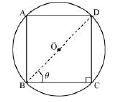 In ∠DBC = θ In right ΔBCD ; = cos θ ⇒ BC = BD cos θ = 2r cos θ = sin θ ⇒ CD = BF sin θ = 2r sin θ Let A be the area of rectangle ABCD. ∴ A = BC × CD ⇒ A = 2r cos θ 2r sin θ = sin θ cos θ ⇒ A = sin 2θ , sin 2θ = 2 sin θ cos θ ∴ = 2 . cos 2θ = cos 2θ Now , = 0 ⇒ cos 2θ = 0 ⇒ cos 2θ = 0 ⇒ cos 2θ = cos ⇒ θ = = - 2 . sin 2θ = - sin 2θ ∴ = = - . 1 = < 0 Therefore, by the second derivative test, θ = is the point of local maxima of A. So, the area of rectangle ABCD is the maximum at θ = Now, θ = ⇒ = tan ⇒ = 1 ⇒ CD = BC ⇒ Rec tangle ABCD is a square Hence, the rectangle of the maximum area that can be inscribed in a circle is a square. OR Let a cylinder be inscribed in a cone of radius R and height h. Let the radius of the cylinder be r and its height be .
 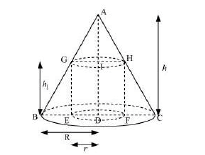 It can be easily seen that Δ AGI and Δ ABD are similar. ∴ = ⇒ = ⇒ r = (h - ) Volume (V) of the cylinder = ⇒ V = ⇒ V = ⇒ =
⇒ = Now, = 0 ⇒ = 0 ⇒ = 0 ⇒ = 0 ⇒ = 0 ⇒ (3h_1-h) = 0 ⇒ = h , = It can be noted that if = h, then the cylinder cannot be inscribed in the cone. ∴ = Now, = (0 + 6 - 4h) = ∴ = = < 0 Therefore, by the second derivative test, = is the point of local maxima of V. So, the volume of the cylinder is the maximum when = Hence, the height of the cylinder of the maximum volume that can be inscribed in a cone of height h is h
© examsnet.com
Go to Question: