Test Index
CBSE Class 12 Physics 2016 Outside Delhi Set 1 Paper
© examsnet.com
Question : 24 of 26
Marks:
+1,
-0
SECTION - E
(i) Draw a labelled diagram of a step-down transformer. State the principle of its working. (ii) Express the turn ratio in terms of voltages. (iii) Find the ratio of primary and secondary currents in terms of turn ratio in an ideal transformer. (iv) How much current is drawn by the primary of a transformer connected to supply when it delivers power to a refrigerator? OR (a) Explain the meaning of the term mutual inductance. Consider two concentric circular coils, one of radius and the other of radius placed coaxially with centres coinciding with each other. Obtain the expression for the mutual inductance of the arrangement. (b) A rectangular coil of area , having number of turns is rotated at ' ' revolutions per second in a uniform magnetic field , the field being perpendicular to the coil. Prove that the maximum emf induced in the coil is .
Solution:
(i) Principle of working: It works on the principle of mutual induction i.e. if two coils are inductively coupled and when current or magnetic flux is changed through one of the two coils, then induced e.m.f. is produced in the other coil. 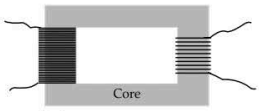 (ii) Turns ratio is A transformer with a primary winding of 1000 turns and secondary winding of 100 turns has a turns ratio of or . Therefore, 100 volts applied to primary winding will produce a secondary voltage of 10 volts. (iii) (iv) Now, OR (a) Meaning of Mutual Inductance Expression (b) Proof Diagram (a) Mutual Inductance is the property of a pair of coils due to which an emf induced in one of the coils due to the change in the current in the other coil. Let a current flows through the outer circular coil. Then Thus (b)
 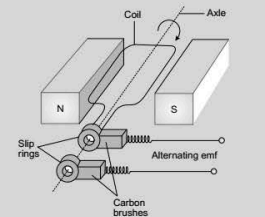 Flux at any time ' '. From Faraday's Law, induced emf Thus the instantaneous value of emf is For maximum value of emf i.e.,
© examsnet.com
Go to Question: