Test Index
CBSE Class 12 Physics 2017 Delhi Set 2 Paper
© examsnet.com
Question : 7 of 8
Marks:
+1,
-0
A electron of mass revolves around a nucleus of charge . Show that it behaves like a tiny magnetic dipole. Hence prove that the magnetic moment associated with it is expressed as , where is the orbital angular momentum of the electron. Give the significance of negative sign.
Solution:
(i) Behaviour of revolving electron as a tiny magnetic dipole (ii) Proof of the relation (iii) Significance of negative sign Electron, in circular motion around the nucleus, constitutes a current loop which behaves like a magnetic dipole. Current associated with the revolving electron : 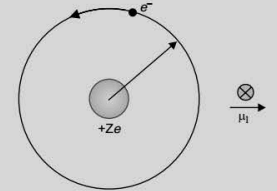 Magnetic moment of the loop, Orbital angular momentum of the electron -ve sign signifies that the angular momentum of the revolving electron is opposite in direction to the magnetic moment associated with it.
© examsnet.com
Go to Question: