Test Index
CBSE Class 12 Physics 2023 Delhi Set 1 Paper
© examsnet.com
Question : 26 of 35
Marks:
+1,
-0
SECTION - C
(a) A plane wave-front propagating in a medium of refractive index ' ' is incident on a plane surface making an angle of incidence (i). It enters into a medium of refractive index . Use Huygen's construction of secondary wavelets to trace the retracted wave-front. Hence, verify Snell's law of refraction. OR (b) Using Huygen's construction, show how a plane wave is reflected from a surface. Hence, verify the law of reflection.
Solution: 👈: Video Solution
(a) A plane wavefront is incident on the plane of separation XY of two media of refractive indices and making an angle . This is known as angle of incidence. When the wavefront touches the point , the point becomes a source of secondary wavelets. Thus, when the whole waveform passes through the plane, each point of AF becomes the source of secondary wavelets. 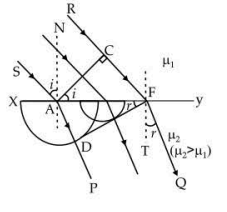 When point of the wavefront in medium 1 traverses CF distance by that time the wavelet from point traverses distance. If and are the speeds of light in medium 1 and 2 respectively, then and . Refracted wavefront DF which is obtained by drawing a tangent to the arc having radius and centre . The angle made by the tangent with the plane is . This is known as angle of refraction. The perpendiculars drawn on wavefront are the incident rays. The perpendiculars drawn on wavefront are the refracted rays. and TF are the perpendiculars drawn on , the plane of separation of the two media. In , This is Snell's law. OR (b) A plane wavefront is incident on a plane reflector making an angle . This is known as angle of incidence. Each and every point of the wavefront when touches the reflector becomes a source of secondary wavelets. When the wavefront touches the point , the point becomes a source of secondary wavelets. Thus, when the whole waveform touches the XY plane, each point of AF becomes the source of secondary wavelets. When point of the wavefront in medium 1 traverses CF distance by that time the wavelet from point traverses distance. If is the speeds of light in medium then and . Reflected wavefront DF which is obtained by drawing a tangent to the arc having radius and centre . The angle made by the tangent with the plane is . This is known as angle of refraction.
 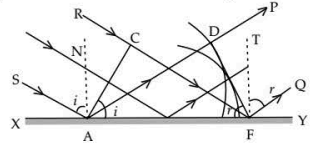 The perpendiculars drawn on wavefront are the incident rays. The perpendiculars drawn on wavefront DF are the reflected rays. and TF are the perpendiculars drawn on , the plane reflector.In and is the common sideSo, the triangles are congruent.This is law of reflection.
© examsnet.com
Go to Question: