Concept:For a reversible first-order reaction
R⇌P at constant temperature, the equilibrium concentrations are determined by the ratio of rate constants, and the concentrations change exponentially until equilibrium is reached.
Explanation:Given
kb=4kf, the equilibrium constant is
Keq=kbkf=41.
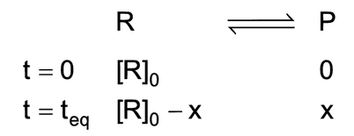
Let
x be the amount of
R converted to
P at equilibrium.
Then
[P]=x and
[R]=[R]0−x.
From
Keq=[R][P]=[R]0−xx=41, we get
4x=[R]0−x, so
x=5[R]0.
At equilibrium:
[R]0[P]=51=0.2 and
[R]0[R]=54=0.8.
At
t=0:
[R]0[R]=1,
[R]0[P]=0.
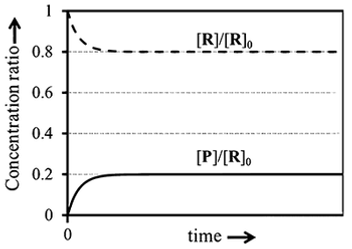
As reaction proceeds,
[R]/[R]0 decreases from 1 to 0.8, and
[P]/[R]0 increases from 0 to 0.2, both approaching their equilibrium values exponentially.
Answer:The correct graphical representation is the one where
[R]0[R] starts at 1 and asymptotically approaches 0.8, while
[R]0[P] starts at 0 and asymptotically approaches 0.2.