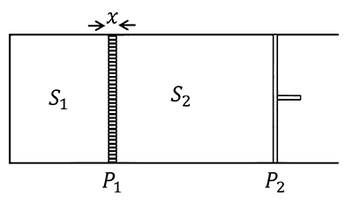
Concept:The problem combines heat transfer through a conducting partition with thermodynamics of ideal gases undergoing different processes.
Explanation:The container has two sections
S1 and
S2, each with 1 mole of monoatomic gas.
S1 is rigid (constant volume) → isochoric process; molar heat capacity
Cv=23R.
S2 has a movable piston maintaining constant atmospheric pressure → isobaric process;
Cp=25R.
Let
T1 and
T2 be instantaneous temperatures of
S1 and
S2, with
T1>T2.
Heat
dQ flows from
S1 to
S2 through partition of conductivity
K, area
A, thickness
x.
For
S1 (isochoric cooling):
dQ=−nCvdT1=−23RdT1 →
dT1=−3R2dQ.
For
S2 (isobaric heating):
dQ=nCpdT2=25RdT2 →
dT2=5R2dQ.
Change in temperature difference:
d(ΔT)=dT1−dT2=−15R16dQ.
Heat transfer rate:
dtdQ=xKA(T1−T2)=xKAΔT →
dQ=xKAΔTdt.
Substitute:
d(ΔT)=−15xR16KAΔTdt →
ΔTd(ΔT)=−15xR16KAdt.
Integrate from initial
ΔT0 to
2ΔT0 over time
τ:
∫ΔT0ΔT0/2ΔTd(ΔT)=−15xR16KA∫0τdt →
ln21=−15xR16KAτ.
Thus
−ln2=−15xR16KAτ →
τ=1615ln2⋅KAxR.
Given
ln2≈0.7,
n=1615×0.7=0.65625≈0.66.
Answer:n≈0.66.