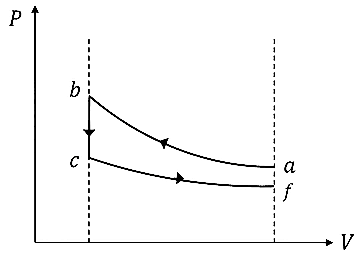
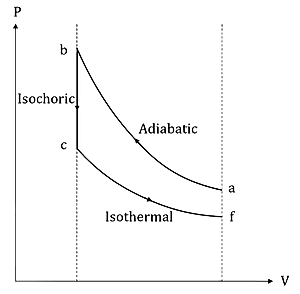
Concept:The processes involve an adiabatic compression followed by isochoric cooling and isothermal expansion.
Explanation:The sudden compression from state
a to
b is adiabatic because there is no time for heat exchange.
For an adiabatic process,
TVγ−1 is constant.
For a monoatomic ideal gas,
γ=35 so
γ−1=32.
Given
Ta=27∘C=300K and
Va=V0,
Vb=V0/3.
From
TaVaγ−1=TbVbγ−1, we get
300×V02/3=Tb×(V0/3)2/3.
Thus
Tb=300×32/3=300×(9)1/3.
Using
(9)1/3=2.08,
Tb≈624K.
Pressure at
b:
Pb=Pa(VbVa)γ=Pa×35/3≈6.24Pa, not
2.08Pa. So option D is wrong.
Change in internal energy from
a to
b:
ΔUa→b=nCv(Tb−Ta).
n=10,
Cv=23R, so
ΔU=10×23R×(624−300)=15R×324=4860R. Option B is correct.
Process
b→c is isochoric (constant volume) while gas cools to water bath temperature
Tc=11∘C=284K.
Process
c→f is isothermal at
284K; piston is brought back to original volume
Vf=V0.
The schematic P‑V diagram correctly shows: adiabatic steep curve (
a→b), vertical isochoric line (
b→c), isothermal curve (
c→f).
Thus option A is correct.
Net change in internal energy for the whole cycle depends only on initial and final temperatures (state function):
ΔUnet=nCv(Tf−Ta).
Ta=300K,
Tf=284K, so
ΔUnet=10×23R×(284−300)=15R×(−16)=−240R. Option C is correct.
Answer:Options A, B, C.