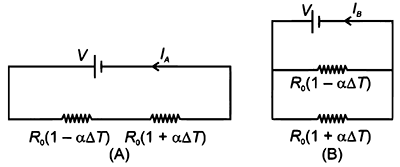
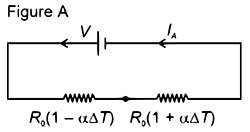
Concept:In circuit A, resistors are in series.
Their temperature coefficients cancel out, making total resistance constant.
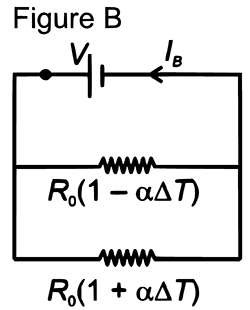
In circuit B, resistors are in parallel, and their combined resistance decreases with temperature.
Explanation:For circuit A (series):
The total resistance is
R0(1+αΔT)+R0(1−αΔT)=2R0, which is independent of temperature.
Therefore, the current
IA=V/(2R0) remains constant.
For circuit B (parallel):
The equivalent resistance is
R0(1+αΔT)+R0(1−αΔT)R0(1+αΔT)⋅R0(1−αΔT)=2R0(1−α2(ΔT)2).
As temperature rises,
α2(ΔT)2 increases, so the numerator decreases.
Hence
Req decreases.
Since
IB=V/Req, the current
IB increases with temperature.
Answer:IA remains constant while
IB increases.
So the correct option is B.